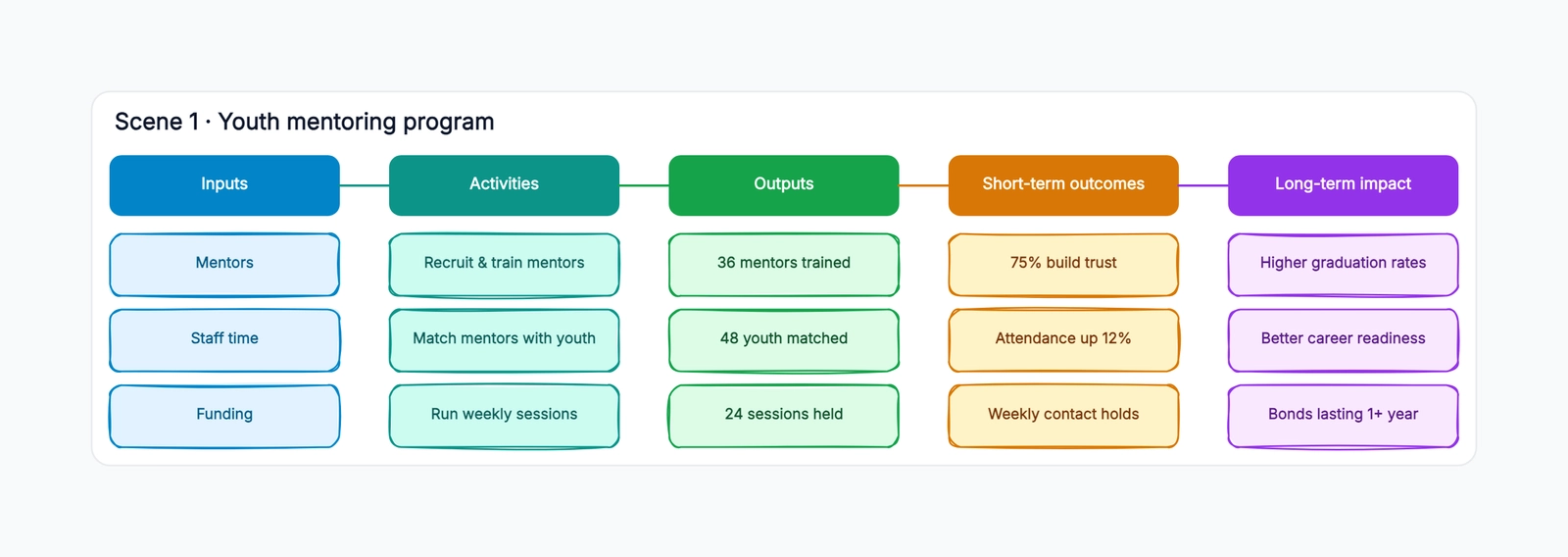
Nonprofit logic model examples are useful because they show the level of detail a blank five-column diagram cannot. A strong model does not say “we provide support, therefore communities improve.” It names the resources, the work, the countable reach, the near-term change, and the longer-term impact—and leaves room to question each link.
The examples below are starting points, not promises about what every program will achieve. Adapt the nonprofit logic model template with your own evidence, population, and evaluation plan.
Example 1: Youth mentoring program
Inputs: trained mentors, a program coordinator, safeguarding procedures, meeting space, partner schools, and transportation support. Activities: recruit and screen mentors, train them, match young people, run weekly sessions, and coordinate with schools. Outputs: mentors trained, matches made, sessions delivered, and attendance recorded.
The short-term outcomes might be stronger trust with an adult, improved school attendance, or greater confidence in setting goals. Long-term impact could be improved graduation readiness or connection to employment and education. Notice the distinction: “50 mentoring sessions” is an output; “participants attend school more consistently” is an outcome. The model should identify how the program will observe the latter rather than assuming it.
Example 2: Food access program
Inputs can include food supply, volunteers, distribution space, referral partners, refrigeration, and data systems. Activities include sourcing food, scheduling distribution, providing culturally appropriate options, and connecting households to benefits or local services. Outputs are households served, boxes distributed, referrals completed, and distribution days.
Short-term outcomes may be more reliable access to food and stronger awareness of available support. Longer-term impact might be reduced food insecurity or improved household stability. A common mistake is treating pounds of food distributed as impact. It is important operational evidence, but it does not by itself show whether access improved for participating households.
Example 3: Workforce training program
Inputs include instructors, employer partners, curriculum, devices, participant supports, and employer demand data. Activities include recruitment, skills assessment, classes, coaching, credentials, and employer introductions. Outputs are participants enrolled, hours completed, credentials earned, interviews arranged, and placements supported.
Short-term outcomes might be increased job-search confidence, demonstrated skills, or completed credentials. Long-term impact could be stable employment and improved income. The causal links should be realistic: credentials may create opportunity, but placement also depends on labor-market conditions, accessibility, and employer practices. Put key assumptions beside the model instead of hiding them.
How to test the chain
Read any example left to right and ask five questions. Do we actually have the stated inputs? Can the activities be delivered at the intended quality and frequency? Are outputs defined as counts rather than vague accomplishments? Is there a plausible mechanism from output to outcome? What external conditions could change the long-term impact?
Then read it right to left. If the long-term outcome is important, what nearer change must happen first? What participant behavior or system condition would show it? Which activity creates that condition? This reverse test exposes outcome statements that sound desirable but have no visible route from the program’s work.
Use examples without copying claims
Examples are most valuable when they help a team select the right level of specificity. Replace every example noun and number with your own evidence. Keep the columns, causal arrows, and distinction between direct work and experienced change. For a companion application workflow, see the grant application process flowchart guide.
When your first version is complete, ask program staff, participants or partners where appropriate, and evaluation colleagues to challenge one link at a time. The goal is not to produce an impressive page. It is to create a shared, testable explanation of how the program expects to create change.