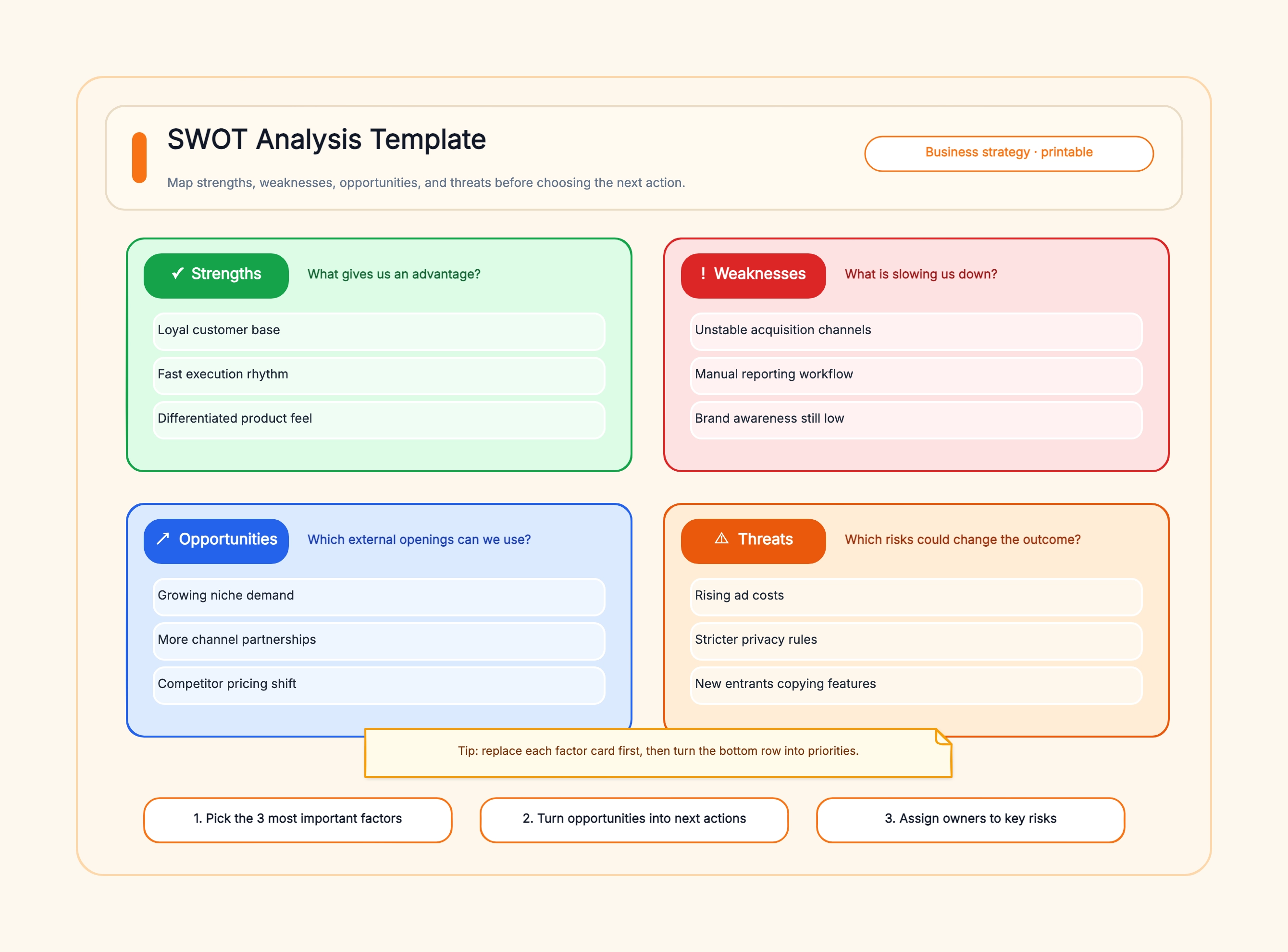
Early-stage startup SWOT
Who uses it: Founder preparing a strategic plan for investors or co-founders
Strengths: Founding team domain expertise | Early customer traction | Lean cost base
Weaknesses: No marketing function | Product gaps vs. incumbents | Founder-led sales only
Opportunities: Incumbents slow to innovate | Growing segment | Partnership channels available
Threats: Well-capitalized competitors | Key-person dependency | Runway under 12 months
Why this works: A startup SWOT is most useful when it forces founders to be honest about weaknesses — listing only strengths and opportunities produces a document that feels good but does not help prioritize where to invest.
Product launch SWOT
Who uses it: Product manager assessing readiness before a major release
Strengths: Beta feedback positive | Strong integration ecosystem | Existing user base to cross-sell
Weaknesses: No mobile version at launch | Pricing higher than alternatives | Support team under-staffed
Opportunities: Competitor exiting market | Seasonal demand spike | Press coverage opportunity
Threats: Launch window crowded | Key feature requested but not shipped | Churn risk from existing users
Why this works: Running a SWOT before a product launch surfaces risks that the roadmap does not capture — the Threats quadrant often reveals go-to-market gaps that engineering cannot fix.
Marketing campaign SWOT
Who uses it: Marketing manager evaluating a channel or campaign strategy
Strengths: Strong brand content library | Loyal community | High email open rates
Weaknesses: Low paid media expertise | No influencer relationships | Weak SEO foundation
Opportunities: Viral campaign trend in category | Competitor brand crisis | New platform audience
Threats: Ad costs rising | Algorithm changes reducing organic reach | Audience fatigue
Why this works: A channel-level SWOT helps marketers decide where to double down and where to stop investing — without it, budget decisions get made on gut feel rather than a structured view of leverage.
Career decision SWOT
Who uses it: Professional evaluating a job offer, promotion, or career pivot
Strengths: Deep expertise in current domain | Strong network in industry | High performance record
Weaknesses: No experience in target role | Gap in technical skills | Limited visibility outside current company
Opportunities: Role offers equity upside | New skills aligned with market demand | Mentor available
Threats: Job market softening | Long ramp time before impact | Risk of leaving stable position
Why this works: Applying SWOT to a personal career decision makes the trade-offs explicit — most people focus on Opportunities when evaluating a new role and underweight the Threats and Weaknesses quadrants.
Competitor analysis SWOT
Who uses it: Business analyst or strategist researching a key competitor
Strengths: Market leader brand | Deep enterprise relationships | Superior distribution
Weaknesses: Legacy tech stack | Slow product velocity | High price point
Opportunities (for us): Attack SMB segment they ignore | Build integrations they lack | Win on speed
Threats (for us): They acquire our space | Price war | Enterprise sales cycle we cannot match
Why this works: A competitor SWOT is most actionable when the Opportunities quadrant maps directly to the competitor's Weaknesses — that intersection is where a challenger can win.
Educational SWOT case study
Who uses it: Student analyzing a business case for a class or exam
Strengths: Strong cash reserves | Established brand | Diversified revenue streams
Weaknesses: Over-reliance on single product | Aging customer base | High operating costs
Opportunities: Emerging market entry | Digital transformation trend | Partnership to fill product gap
Threats: Regulatory tightening | Disruptive new entrant | Supply chain disruption
Why this works: In an academic context, the value of a SWOT diagram is showing the examiner that you can categorize information correctly — internal vs. external and positive vs. negative — not just listing facts.